
Restoring hair, naturally, with your own biology
Platelet-rich plasma therapy uses growth factors drawn from your own blood to help revive thinning hair and support fuller, healthier growth over time — with no synthetic drugs and no surgery.
Book a Consultation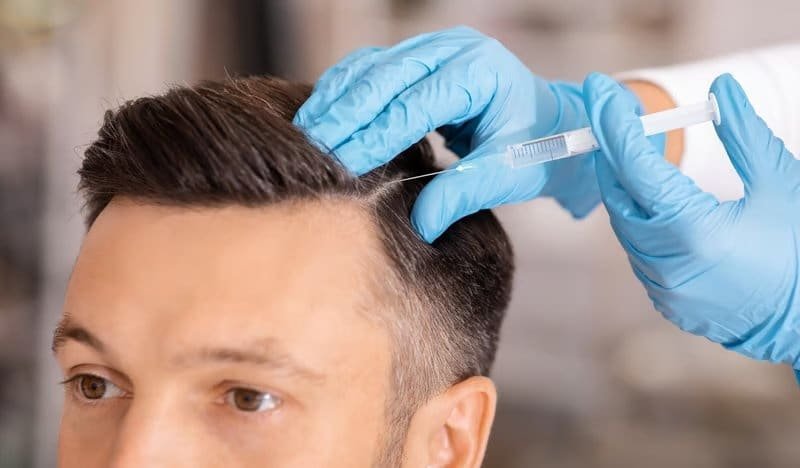
What PRP hair restoration actually does
Platelet-rich plasma (PRP) is a concentration of your own platelets and growth factors, separated from a small blood draw using a centrifuge. These platelets contain proteins that signal tissue repair and stimulate cellular activity wherever they're introduced.
When injected into the scalp, PRP is thought to extend the growth phase of the hair follicle, improve blood supply around the follicle, and support the health of follicles that have started to miniaturize — a hallmark of androgenetic (pattern) hair loss.
Because the plasma is autologous — drawn from and returned to the same patient — there is no risk of allergic reaction or disease transmission from the injection itself, and no synthetic medication is introduced into the body.
100% Autologous
Derived entirely from the patient's own blood — nothing synthetic or donor-derived is introduced.
3–4 Sessions
Typical initial course, spaced four to six weeks apart, followed by periodic maintenance.
~45 Minutes
Approximate in-office visit length, including blood draw, preparation, and scalp injections.
Explore the scalp treatment zones
Hair loss doesn't affect the whole scalp equally. Select a zone below to see how it's typically affected and how PRP is applied there.
Tap a marker on the diagram
Each zone of the scalp tends to thin differently, and PRP injection depth, pattern, and frequency are adjusted accordingly. Choose a marker to learn more.
Ask About This ZoneGood candidates for PRP hair restoration
PRP works best as an early-to-moderate intervention, supporting follicles that are still active rather than restoring follicles that have fully scarred over. A consultation with our physician-led team will confirm suitability for your specific pattern of hair loss.
Early androgenetic alopecia
Men and women in the early-to-moderate stages of pattern hair loss, where thinning is present but follicles remain viable, tend to see the most noticeable response.
Diffuse thinning
Patients experiencing generalized thinning in density rather than complete bald patches, including early telogen effluvium once underlying causes have been addressed.
Post-transplant support
Patients who have had hair transplant surgery and want to support graft survival and surrounding follicle health during recovery.
Those seeking a non-surgical option
Patients who prefer to explore a lower-intervention option before considering hair transplant surgery or committing to long-term topical or oral medications.
What to expect during treatment
Every session is performed in our clinic under physician oversight, from blood draw through to the final injection.
Consultation & scalp assessment
Our physician reviews your history, examines your pattern of loss, and confirms PRP is an appropriate option — sometimes alongside complementary therapies for optimal results.
Blood draw & preparation
A small sample of blood is drawn, much like a routine lab test, then processed in a centrifuge to separate and concentrate the platelet-rich plasma.
Scalp preparation
The treatment area is cleansed, and a topical or local numbing approach is applied to keep the injections comfortable.
PRP injections
The concentrated plasma is injected in a grid pattern across the areas of thinning, targeting the depth where hair follicles reside.
Aftercare
Most patients return to normal activity the same day. Mild scalp tenderness or swelling can occur for a day or two, and hair should not be washed for a short window following treatment as advised by our team.
Expected results
PRP works gradually, in step with the natural hair growth cycle, so results build over months rather than appearing immediately.
No visible change yet. Beneath the surface, growth factors are beginning to influence follicle activity and local blood flow.
Many patients notice reduced shedding first, along with early improvements in hair texture and scalp appearance.
Increased density and thickness typically become more apparent as follicles cycle through renewed growth phases.
Periodic maintenance sessions, often every 6–12 months, help sustain results as the natural hair cycle continues.
Pairing PRP with exosome therapy
Some patients choose to add exosome therapy to their PRP treatment plan as a complementary step. It is entirely optional and discussed on a case-by-case basis during consultation — never bundled in without a clear conversation about cost and expected benefit.
What exosomes are
Exosomes are tiny, cell-derived signaling particles that carry proteins and growth factors similar to those found in PRP, but in a more concentrated, cell-free form. The exosome products used in aesthetic medicine are typically sourced from screened donor or plant-based tissue rather than the patient's own blood.
How they complement PRP
Where PRP delivers a broad mix of growth factors from your own platelets, exosome solutions are formulated to concentrate specific signaling molecules thought to support follicle activity. Applied alongside PRP, the two are intended to work on overlapping but slightly different mechanisms of scalp and follicle health.
Who might consider adding it
Patients who have completed an initial PRP course with a partial response, or who want to layer additional support onto their treatment plan, sometimes choose to add exosomes. Our physician can help determine whether this addition is likely to be worthwhile for your specific pattern of hair loss.
What to expect at the visit
When added to a session, exosome solution is applied to the scalp following the PRP injections, either through micro-injections or in conjunction with microneedling, adding a modest amount of time to the appointment.
Uninsured service. PRP hair restoration, and optional add-ons such as exosome therapy, are elective, privately billed services and are not covered by OHIP. Fees, the number of recommended sessions, and payment details are disclosed in full and confirmed in writing before treatment begins, in accordance with the Colleges' policies on uninsured services and the Cosmetic Facilities Model Act (CFMA).
Physician-led care. All treatment plans are assessed and overseen by a licensed physician in accordance with CPSO expectations for delegated procedures and informed consent.
Informed consent. Before any injection, patients receive a full explanation of the procedure, expected benefits, possible risks and side effects, and reasonable alternatives, and are given the opportunity to ask questions.
This page is provided for general educational purposes and does not constitute medical advice or a guarantee of outcome. Please book a consultation to discuss whether PRP hair restoration is appropriate for you.
Start with a conversation, not a commitment
Book a consultation with our physician-led team to find out whether PRP hair restoration fits your goals.
Request a Consultation